Two ways size gets into the options market
Pull up any flow feed during market hours and the two labels you will see most are sweep and block. Most flow tools display them as if they were interchangeable flavors of large trade, and they are not. A sweep and a block solve different execution problems, and they leave different evidence about intent on the tape.
If you trade off flow, the distinction is worth getting exactly right, because the most common retail mistake with both is the same one: reading the label as a direction call. This page covers how each order type actually executes, what each implies about the trader behind it, and the specific contexts where each one carries real information.
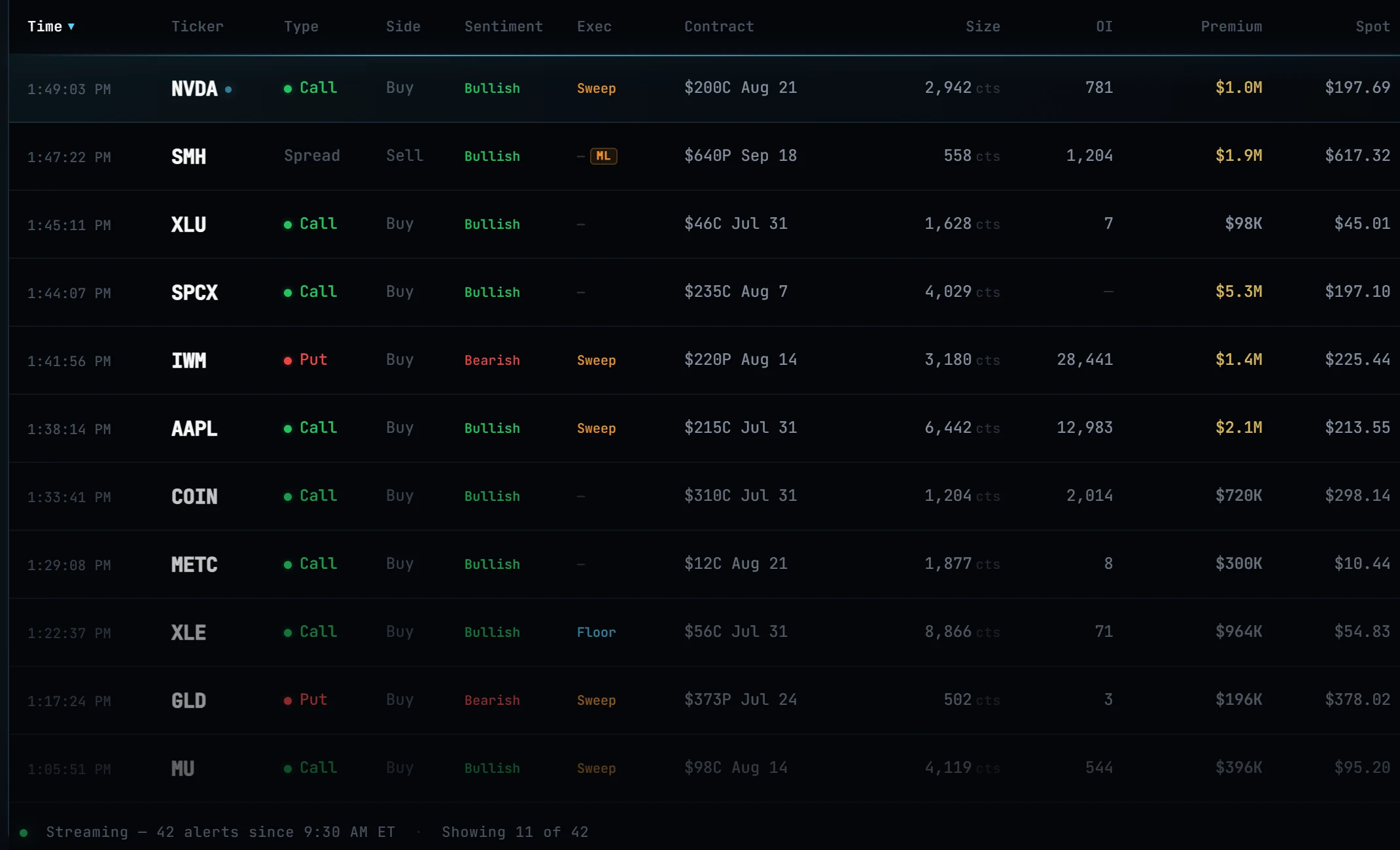
What an options sweep is
US options trade on more than a dozen exchanges at once, and the best displayed price for a contract is usually spread thinly across several of them. A sweep is a marketable order split into pieces and routed to multiple exchanges simultaneously, taking whatever displayed liquidity exists up to the trader's limit price. Instead of resting an order and waiting for a fill, the sweep crosses the spread and lifts offers (or hits bids) at several venues, often at several price levels, in the same instant.
On the tape, a sweep looks like a burst of small-to-mid prints in the same contract, timestamped within the same second, across different exchanges, executing at or through the quoted price. The trader paid for that. Crossing the spread and walking up price levels costs real money relative to working the order patiently.
That cost is where the information lives: the trader accepted a worse price in exchange for speed and certainty of fill. The sweep tells you the trader was in a hurry, not why.
What a block trade is
A block is a single large trade negotiated away from the public order book, typically through a broker's desk that finds the other side of the trade privately, then prints it to an exchange as one transaction at one agreed price, under the exchange's crossing rules. Traders call this the upstairs market.
Blocks typically print inside the quoted spread, often near the midpoint, because the price was negotiated rather than one side paying up to get filled. They are also frequently part of a package: tied to a stock position, or one leg of a spread, collar, or roll that was negotiated as a unit.
The block trader's priorities run opposite to the sweep trader's: they wanted size done at a known price with minimal market impact, and they were willing to spend time and use relationships to get it, so the signature is patience rather than urgency.
Side by side
The practical differences compress into a short table.
| Sweep | Block | |
|---|---|---|
| Execution style | Split across multiple exchanges at once, taking displayed liquidity | Negotiated privately, printed as one trade at one price |
| Typical fill price | At or through the bid/ask, sometimes walking multiple levels | Inside the spread, often near the midpoint |
| Urgency signal | High. The trader paid the spread for immediate fills | Low. The trader waited for a negotiated price |
| Who typically uses it | Anyone who wants in now: fast money, traders acting on short-lived information, or simply an algo filling a routine order | Institutions moving size: funds hedging, rolling, or building positions through a desk |
| Aggressor readability | Usually readable. Crossing the spread points at the initiating side | Usually unreadable. A negotiated print does not reveal who wanted the trade |
| What it implies about intent | Speed mattered more than price | Size and discretion mattered more than speed |
| Directional read on its own | Partial. Side is often inferable, purpose is not | Weak. Neither side nor purpose is inferable from the print alone |
How to tell who initiated the trade
The core inference technique in flow reading is comparing the fill price to the prevailing bid and ask. A fill at or above the ask suggests the buyer initiated, since the buyer paid the seller's price to get filled. A fill at or below the bid suggests the seller initiated. Traders call the initiating side the aggressor.
Sweeps make this readable almost by construction. An order that crosses the spread across five exchanges in one second was initiated by whichever side did the crossing. Blocks erase the evidence: a print negotiated inside the spread tells you a trade happened and how big it was, and very little else. Some feeds still stamp blocks bullish or bearish, but a negotiated print does not support that inference, and the honest tag is neutral or unknown.
Two caveats worth internalizing. First, aggressor inference is probabilistic even on clean sweeps. Price improvement, tied stock, and market-maker behavior all muddy individual prints, so treat the read as evidence rather than proof. Second, aggressor is not the same as opening. A trader can aggressively buy calls to close a short call position. The standard check for opening versus closing is whether open interest in the contract rises the next morning by roughly the traded size. It is a rough check, since other trading in the contract that day can mask or mimic the change, and it means the confirmation always arrives a day late. Anyone who tells you they can be certain intraday is overclaiming.
When a sweep actually matters
Most sweeps are noise. A lot of retail flow actually routes to wholesalers or fills in price-improvement auctions rather than sweeping the displayed book, but feeds still tag plenty of small marketable orders as sweeps, and a $40,000 sweep in SPY weeklies is a Tuesday. The prints that deserve attention share a few traits:
- Size against open interest. A sweep larger than the contract's existing open interest cannot be fully closing. Something new is being built.
- Repetition. The same contract swept repeatedly over minutes or hours reads like a trader working into a position and unwilling to wait, which is a stronger statement than one print.
- Aggressive placement. Fills at the ask, especially walking through multiple price levels, mean the urgency was worth paying for.
- Short-dated, out-of-the-money strikes. Premium spent here decays fast, so the trader is implicitly claiming the move happens soon, which at least gives you a specific window to check against the calendar.
None of these traits alone makes a sweep worth following. Stacked together, they describe a trader working against a deadline, which is when urgency occasionally reflects real information.
When a block actually matters
Blocks earn attention differently. Since urgency is absent by design, the signal has to come from size and context: a print that is enormous relative to open interest and typical daily volume in that name, positioning ahead of a known catalyst, or a block in an otherwise sleepy underlying where institutional size has no routine reason to be.
The complication is that a block is frequently one visible piece of a larger structure. Say a desk crosses 10,000 puts and simultaneously prints stock against them. Seen alone, the puts look like a large bearish bet. Seen with the stock leg, it is a hedged package with little directional content. The same problem applies to spreads and rolls: a feed that shows you loose legs will hand you a bearish-looking print that was actually the closing half of a position being rolled forward. This is why whole-structure detection matters, and it is a question worth asking of any feed you rely on.
The trap: neither one is a direction call
The label tells you how a trade executed. Direction requires three more facts the label does not contain: which side initiated, whether the position is opening or closing, and what the trader's book looks like around it. The third cannot be read off the tape at all, and it drives more of the large prints than most flow traders account for.
Say a fund holds two million shares of a name and buys 20,000 puts as protection into earnings. That prints as a giant put block, the kind most feeds paint red. The fund's view on the stock is unchanged and arguably bullish, since they chose to hedge rather than sell. Much of the institutional options tape is exactly this kind of activity: hedges, collars, buy-writes, and rolls, none of which express the naked directional view the print seems to show.
Sweeps carry the same ambiguity in a milder form. An at-the-ask call sweep is probably buyer-initiated, but the buyer may be covering a short, hedging a different book, or one leg of a structure the feed failed to assemble. Urgency plus an inferred side is real information, but it is still not a conviction read on direction, whatever the feed's color-coding implies.
Whether sweeps or blocks are more predictive of returns is contested in the research, and in practice the context around a print tells you more than the category it falls into. A sweep with size, repetition, aggressive placement, and fresh open interest is worth your time; a routine sweep with none of those traits usually is not.
A working checklist for the live tape
When a large print crosses your feed, the questions to ask are the same every time:
- Where did it fill relative to the bid and ask?
- Is it larger than existing open interest, and did OI confirm the next morning?
- Is it a standalone trade or a leg of a structure?
- Is there a scheduled catalyst (earnings, macro print) that explains the timing?
- Has the same contract been hit repeatedly, or is this a one-off?
Most prints fail at least one of these questions. The bulk of the tape is hedging and housekeeping, and the job is mostly learning to ignore it.
If you want to see how scored flow signals behave over time, the Nightglass track record at /performance lists every signal it has issued, winners and losers included, with peak gains labeled as peaks rather than returns.
Questions traders ask
Is an options sweep bullish?
Not by itself. A call sweep at the ask suggests an urgent buyer, but that buyer could be opening a new bullish position, closing a short, or hedging something you cannot see. The sweep establishes urgency; to get to direction you also need the side, whether the trade is opening, and ideally what it is paired with.
Can a trade be both a sweep and a block?
The categories blur at the edges. A very large marketable order can print as a rapid series of sizable fills across exchanges, and some feeds will tag the pieces as blocks while the pattern is functionally a sweep. Focus on the behavior (crossing the spread across venues versus a single negotiated print) rather than the tag.
How do I know if a sweep or block is opening a new position?
Compare the trade size to the contract's current open interest. A trade bigger than all existing OI must be at least partly opening. For anything smaller, check whether OI rises by roughly the traded amount the next morning. There is no reliable way to confirm opening versus closing intraday.
Why do flow tools mark most blocks as neutral?
Because blocks are negotiated privately and print inside the quoted spread at an agreed price, often near the midpoint, there is usually no fill-versus-quote evidence about which side initiated. Marking them neutral reflects what the print actually supports. Tools that force a bullish or bearish label onto negotiated prints are inferring more than the data shows.
Are sweeps more predictive than blocks?
This is genuinely contested, and anyone quoting a definitive answer is selling something. Sweeps give a cleaner read on urgency, and blocks on size. In practice, context (size against open interest, repetition, fill aggressiveness, catalyst timing, whole-structure detection) matters more than which label the print wears.
Everything Nightglass surfaces is scored on a public track record — winners and losers, methodology included. See the tape →